Verify Credentials
Ask for the ROC license number, current insurance certificates, and surety-bond proof before paying a deposit. Required bond amounts typically range from $9,000 to $15,000 depending on license classification.
Tucson Superior Concrete recommends asking about licensing, insurance, written specifications, recent local work, payment terms, and warranty coverage before you sign a concrete contract. Those answers matter because a poorly planned driveway or patio can leave a Tucson property owner with cracking or settlement for the next 20-30 years.
Ask for the ROC license number, current insurance certificates, and surety-bond proof before paying a deposit. Required bond amounts typically range from $9,000 to $15,000 depending on license classification.
The estimate should state concrete strength, compacted-base depth, wire mesh or rebar, control-joint spacing, demolition and haul-off, and whether sealing is included.
Ask for recent local references, then confirm the deposit, milestone payments, final inspection, and separate labor and material warranty terms in writing.
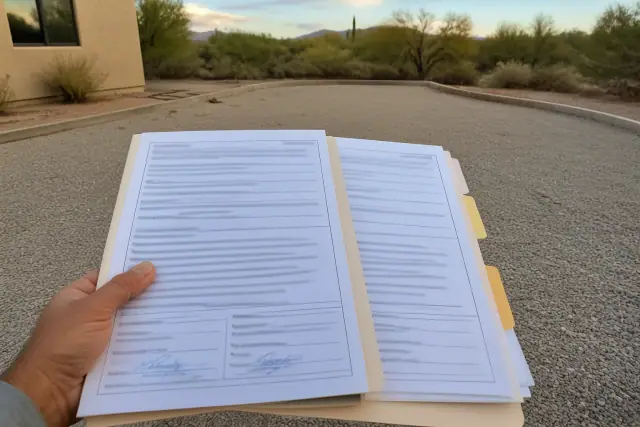
Show the ROC license record, general liability certificate, workers' compensation certificate, and bond proof together. Matching names and current dates make the documents easier to verify.
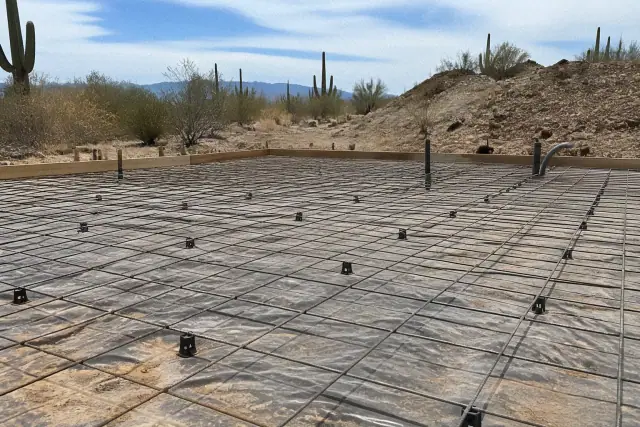
Show a written slab detail with mix strength, base preparation, wire mesh or rebar, joint layout, and a 1/4-inch-per-foot drainage slope. These specifications reveal whether two bids cover the same work.
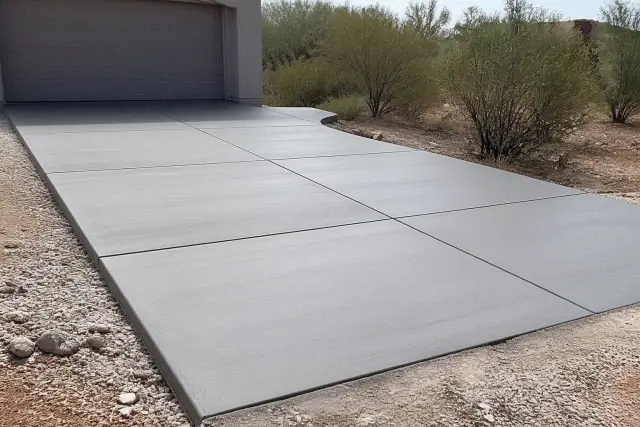
Show an even finished surface, deliberate control joints, and water moving away instead of pooling. A recent local project also gives useful evidence of finishing quality.
Request the ROC license number and verify it yourself, then review current coverage and bond documents before signing or paying.
Project size, access, demolition, reinforcement, base preparation, decorative finish complexity, and penetrating versus topical acrylic sealer choices can all change price and timing.
Walk away from requests for full payment upfront, vague estimates, missing local references, or reluctance to show licensing and insurance proof.
Do not reveal your maximum budget before receiving a detailed estimate, accept an open-ended schedule, or rely on verbal warranty and payment promises.
| Concrete project | Typical cost range | Typical timeline |
|---|---|---|
| Driveway installation | $8-$14 per sq ft | 3-5 days including cure |
| Patio installation | $10-$16 per sq ft | 2-4 days |
| Stamped concrete | $12-$20 per sq ft | 3-5 days |
| Sidewalks and walkways | $6-$9 per sq ft | 1-3 days |
| Slab installation | $6-$12 per sq ft | 2-4 days |
| Foundations and footings | $7-$14 per sq ft | 4-7 days |
| Repair and resurfacing | $3-$8 per sq ft | 1-2 days |
| Pool decks | $12-$20 per sq ft | 3-6 days |
Strong answers are specific and verifiable. Ask for an active Arizona Registrar of Contractors license issued under Arizona Revised Statutes Title 32, Chapter 10, plus current general liability, workers' compensation, and surety-bond documents. Technical answers should identify ready-mix meeting ASTM C94, relevant American Concrete Institute flatwork finishing practices, and a curing approach suited to Tucson temperature swings from summer highs above 105 degrees to winter nights near freezing.
Residential driveways and patios usually call for 3,000 to 4,000 PSI concrete, while structural foundations and footings require higher strength. The contractor should explain subgrade compaction and moisture conditioning for Tucson caliche and monsoon saturation, control joints typically spaced every 8 to 10 feet, and a controlled cure lasting at least seven days before full design strength develops around 28 days. Written terms should separate a typical one-to-five-year labor warranty from supplier-dependent material coverage and set a modest 10 to 30 percent deposit, progress payments tied to form-setting or the pour, and final payment after inspection.
How can you spot a bad concrete job? Watch for cracks wider than a hairline within the first year, uneven surfaces, pooling water, scaling, dusting, flaking, or significant settlement; inadequate subgrade preparation is a common cause. How long will the work take? Most residential driveways, patios, and walkways take three to five days from form-setting through the initial cure period, while pool decks and larger slabs may take longer because of size and finish complexity. Before choosing, compare the included scope, recent work, communication, scheduling, and written warranty rather than treating the lowest price as the complete answer.
Bring your project details and ask for written answers about the scope, materials, base preparation, drainage, curing, schedule, payment milestones, and warranty before approving work.