Proudly serving Tucson, Oro Valley, Marana, Sahuarita, Green Valley, Vail & surrounding areasCall or Text 24/7: 520-699-3263

Concrete Pool Deck Installation, Resurfacing & Structural Repair in Tucson, AZ

Tucson Superior Concrete installs, resurfaces, and repairs concrete pool decks throughout Tucson and the surrounding metro area. We build new reinforced slabs, restore structurally sound decks with overlays, repair cracks and joints, and apply stamped, colored, textured, and sealed finishes. Each recommendation starts with the pool geometry, yard grade, drainage, soil, and condition of the existing slab.

Sonoran Desert heat, expansive caliche soil, and monsoon moisture put unusual stress on concrete poured at grade. Those conditions can leave a pool deck hot underfoot, cracked, spalled, delaminated, or uneven. We select reinforcement, joint layouts, drainage slopes, and finishes for Tucson heat, UV exposure, wet traffic, and soil movement. A site evaluation helps distinguish a repairable surface problem from damage that calls for slab replacement.

Our crews follow reinforced slab practices and control-joint guidance under ACI 302, pull permits through the applicable Tucson or Pima County jurisdiction, and carry Arizona Registrar of Contractors licensing for the required flatwork and foundation classifications. We explain the tradeoffs among broom, stamped, colored, and resurfaced finishes before work begins.

Tucson Superior Concrete provides concrete pool deck installation and repair in Tucson and nearby Oro Valley, Marana, Sahuarita, Vail, and the Catalina Foothills.

★ ★ ★ ★ ★4.9/5 Average Rating · 20+ Years of Experience · Thousands of Customers Helped · Licensed & Insured · Residential & Commercial

Concrete Pool Deck Options & Benefits

What Is a Concrete Pool Deck?

A concrete pool deck is the structural slab surrounding a pool, not merely a decorative border. It supports foot traffic and furnishings, meets the coping edge, and carries water away from the pool shell and nearby foundation.

A durable deck must account for pool geometry, yard grade, subgrade conditions, reinforcement, control joints, and how the space will be used. Those decisions are especially important where caliche and monsoon moisture can move beneath a slab.

The surface can be broom finished, stamped, integrally colored, coated, or resurfaced with an overlay. Finish selection affects traction, heat gain, maintenance, appearance, and whether an existing slab can be restored without demolition.

Benefits of a Well-Planned Pool Deck

A well-planned pool deck coordinates the subgrade, slab, joints, drainage, finish, color, and sealer as one assembly. That approach improves everyday comfort and maintenance while helping the concrete handle wet traffic and Tucson's soil and climate conditions.

  • Reinforcement and control joints help manage shrinkage and soil-related movement.
  • Positive drainage moves water away from the coping, pool shell, and nearby foundation.
  • Broom, knockdown, textured overlay, and exposed-aggregate finishes improve wet-foot grip.
  • Lighter colors and cool deck coatings limit heat gain compared with darker surfaces.
  • Integral color, stains, and stamped patterns coordinate the deck with stucco, roof tile, and hardscape.
  • The right sealer helps protect the surface from UV exposure, chlorine, and sunscreen oils.
  • Structurally sound slabs can often be repaired or resurfaced instead of removed.
  • Finish and joint choices can be tailored to backyard or commercial pool traffic.
Concrete Pool Deck Services

Pool Deck Installation, Repair & Resurfacing

Tucson Superior Concrete works on new and existing concrete pool decks, from structural slab installation to surface restoration and protective sealing. The right service depends on whether the deck is sound, cosmetically worn, actively cracked, uneven, or ready for a different finish.

Concrete Pool Deck Installation

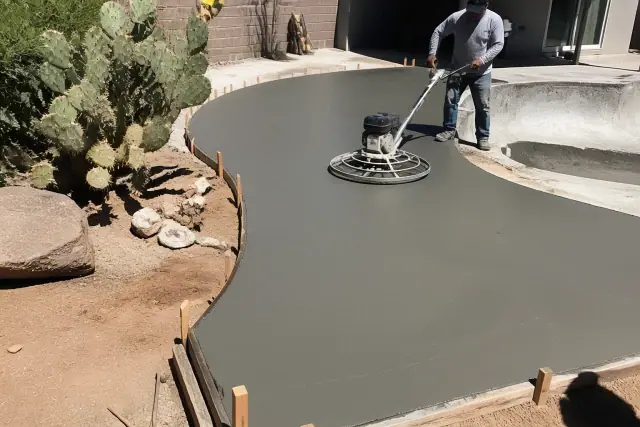
Freshly poured concrete pool deck with wooden forms and cactus landscaping in Tucson, AZ.

New-deck work includes layout, forming, excavation, compacted base preparation, reinforcement, concrete placement, control joints, and the selected finish. The slab is designed around the pool geometry, yard grade, drainage path, load, and the way the poolside space will be used.

Request Estimate

Pool Deck Resurfacing

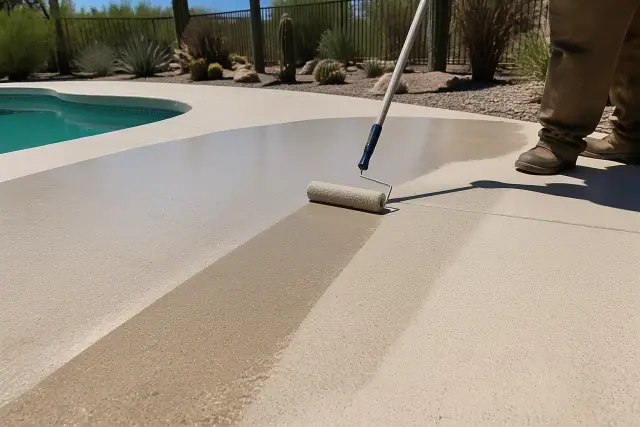
Technician applying a clear sealant to a concrete pool deck in Tucson, AZ.

A cementitious, knockdown, splatter-texture, or decorative stamped overlay can renew a structurally sound deck without demolishing the original slab in most cases. Resurfacing is suited to broad hairline cracking, spalling, faded color, chalking, roughness, or a worn finish when settlement and heaving are not driving the damage.

Request Estimate

Stamped Concrete Pool Decks

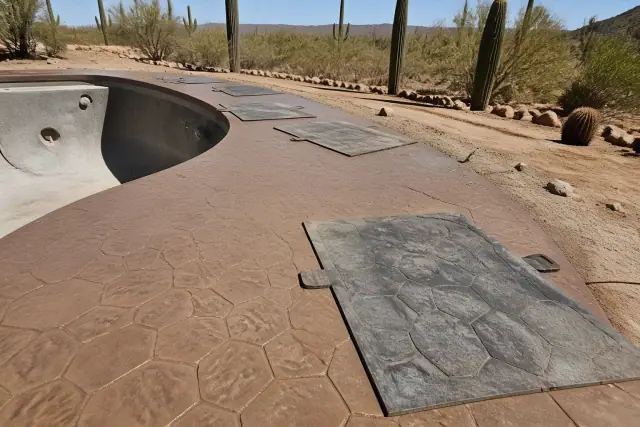
Stamped concrete pool deck installation with stone-like patterns in a Tucson, AZ backyard with saguaro cacti.

Stamped concrete creates the appearance of stone or masonry with patterns such as ashlar slate, travertine, and running bond brick. Integral color or surface-applied color hardener adds tone and variation, while a textured stamp provides better poolside grip than a smooth trowel finish.

Request Estimate

Pool Deck Crack and Joint Repair

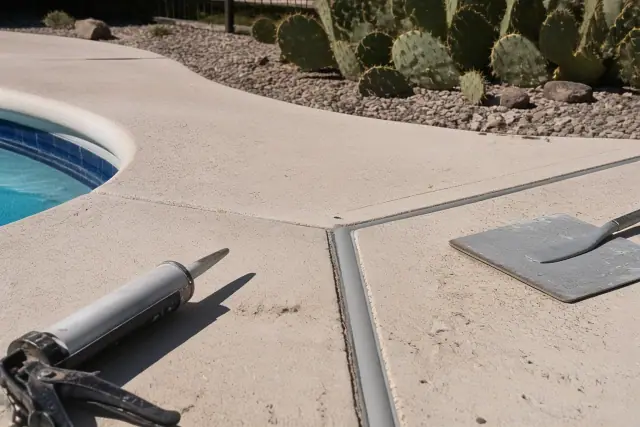
Worker applying flexible joint filler to a concrete pool deck crack in Tucson, AZ.

Active cracks can be routed and filled with flexible polyurethane sealant, and failed expansion-joint material can be replaced. When movement has affected a slab section, the evaluation may point to additional control joints, mudjacking, or section replacement instead of a surface patch that hides the cause.

Request Estimate

Slip-Resistant Pool Deck Finishes

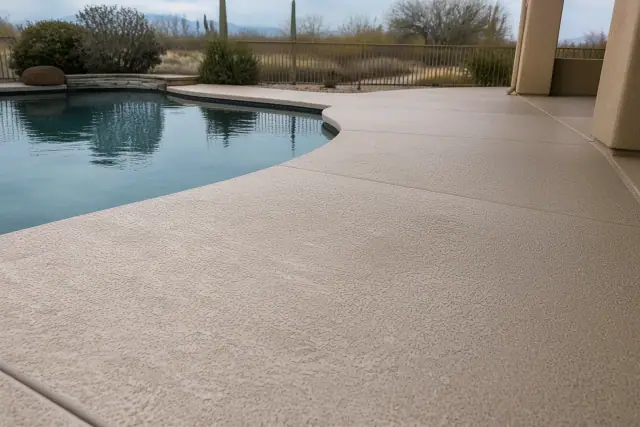
Textured slip-resistant pool deck finish on a residential concrete patio in Tucson, AZ with desert landscape.

Acrylic cool deck coatings and textured overlays add mechanical grip while helping reduce surface temperature. Broom finish, knockdown texture, and exposed aggregate are practical around wet coping edges, and finish recommendations account for the slip-resistance expectations referenced in ANSI/APSP-16 for pool and spa surrounds.

Request Estimate

Pool Deck Sealing and Surface Protection

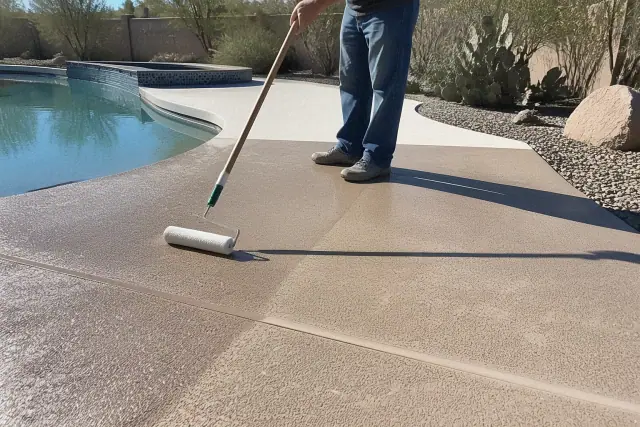
Applying a transparent protective sealer to a concrete pool deck in Tucson, AZ with desert xeriscaping nearby.

Acrylic sealers suit standard broom and stamped finishes, penetrating silane or siloxane products preserve breathability, and film-forming urethane creates a higher-gloss decorative surface. Product selection depends on the finish, desired sheen, and exposure to chlorine, pool chemicals, UV radiation, and moisture.

Request Estimate
Finish and Surface Options

Concrete Pool Deck Finish Options

Pool deck finishes balance appearance with wet-foot traction, heat gain, chemical exposure, and maintenance. Tucson options range from straightforward broom-finished concrete to stamped designs, resurfacing overlays, cool deck textures, integral color, stains, and protective sealers.

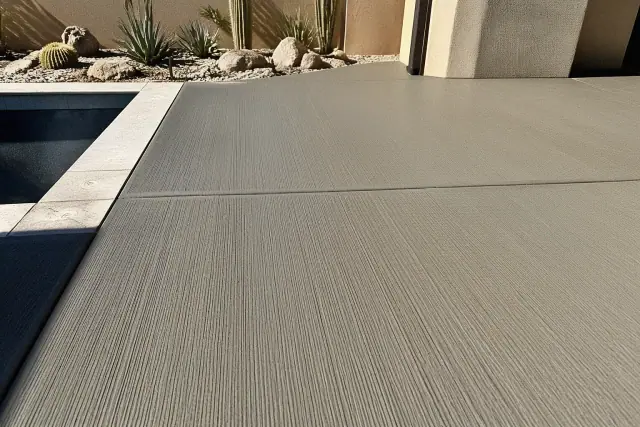
Freshly cured broom-finished concrete pool deck with parallel traction grooves in Tucson, AZ, near desert landscaping.

Broom-Finished Concrete

A broom finish creates fine surface ridges while fresh concrete is still workable. It is a practical choice for homeowners who prioritize straightforward appearance, dependable poolside traction, and compatibility with a standard acrylic sealer.

  • Mechanically textured while the concrete remains workable
  • Better wet-foot grip than a smooth trowel finish
  • Compatible with lighter concrete colors
  • Suited to acrylic surface sealer
  • Functional finish for residential pool areas
Request Estimate
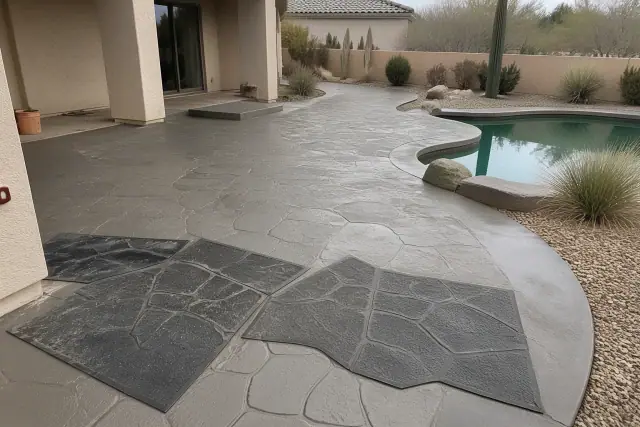
Textured concrete pool deck with stone-like impressions and Sonoran desert landscaping at a home in Tucson, AZ.

Stamped and Decorative Concrete

Stamped concrete delivers a stone- or masonry-inspired pool deck without using natural travertine or flagstone as the deck material. Pattern, base color, accent variation, texture, and sealer are selected together for a cohesive result.

  • Ashlar slate pattern
  • Travertine-inspired texture
  • Running bond brick pattern
  • Integral color or broadcast color hardener
  • Textured surface with scheduled sealing
Request Estimate
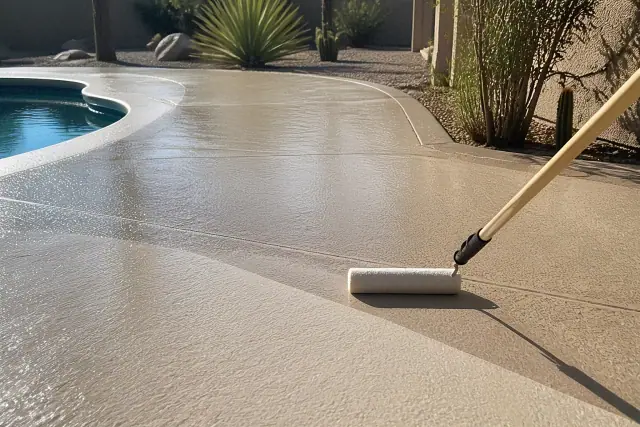
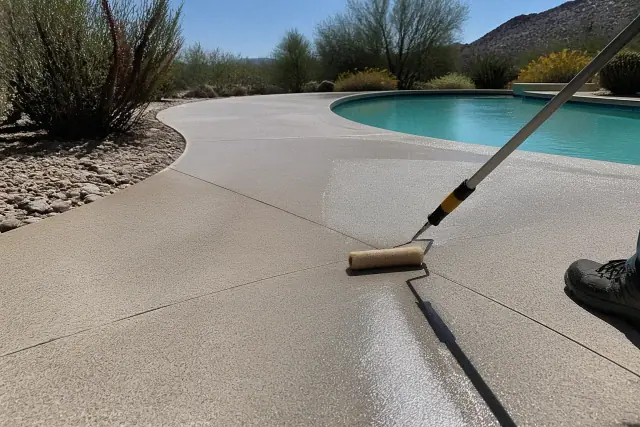
A roller brush applying transparent sealant to a resurfaced concrete pool deck in Tucson, AZ, with desert landscaping.

Pool Deck Resurfacing Overlays

Overlays restore the surface of an existing slab that remains structurally suitable for resurfacing. The method can address cosmetic wear and renew texture without full demolition, but it is not a substitute for correcting serious settlement or heaving.

  • Cementitious overlay
  • Knockdown texture
  • Splatter-texture finish
  • Decorative stamped overlay
  • Renewed appearance and slip resistance
Request Estimate
A technician applying a protective coating to a textured concrete pool deck in Tucson, AZ, with desert cacti in the

Cool Deck and Textured Surfaces

Cool deck acrylic coatings and textured finishes address two practical poolside concerns: direct-sun heat gain and wet-foot traction. Texture is especially valuable at the coping edge and the first few feet of deck where swimmers step out of the pool.

  • Acrylic cool deck coating
  • Knockdown texture
  • Exposed aggregate
  • Broom-textured concrete
  • Grip focused near coping and pool exits
Request Estimate
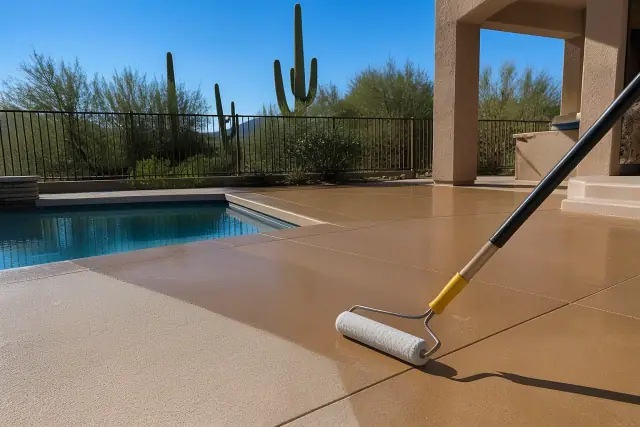
A contractor applies a transparent sealer to a finished concrete pool deck in Tucson, AZ, with saguaro cacti nearby.

Color and Sealer Combinations

Color and sealer choices change the deck's appearance, heat response, sheen, breathability, and resistance to poolside exposure. Lighter desert tan, adobe, terracotta, sand, canyon, and gray-taupe tones can coordinate with Tucson stucco, roof tile, native landscaping, and decomposed granite.

  • Integral color through the slab thickness
  • Acid or water-based stain for variegated color
  • Acrylic sealer for broom or stamped finishes
  • Silane or siloxane sealer where breathability matters
  • Film-forming urethane for a higher-gloss decorative finish
Request Estimate
Choosing the Right Fit

Choosing the Right Pool Deck Approach

The right approach begins with the slab and site rather than a preferred color or pattern. We evaluate soil, drainage, the existing pool shell, cracking, elevation changes, surface wear, sun exposure, and wet-traffic needs before recommending installation, repair, resurfacing, or replacement.

Caliche-Aware Site Evaluation

Caliche does not compact or drain like standard soil, so excavation depth, base placement in lifts, drainage, and control-joint spacing matter. Those construction details can separate a deck that lasts 20 years from one that cracks in five.

Licensed, Permit-Aware Construction

Tucson Superior Concrete carries Arizona Registrar of Contractors licensing for the flatwork and foundation classifications this work requires. We pull permits through Pima County Development Services or the City of Tucson when required and build to ACI 318 and applicable locally adopted International Building Code provisions.

Finish Selection for Tucson Conditions

Finish selection accounts for direct sun, UV exposure, chlorine splash, wet barefoot traffic, surrounding stucco and hardscape, and the desired maintenance level. Darker colors can become noticeably hotter on a 110-degree afternoon, so lighter reflective tones and cool deck coatings are often more comfortable underfoot.

What We Evaluate

Pool Deck Damage and Performance Problems

Pool deck symptoms can begin at the surface or below the slab. Tucson Superior Concrete looks at crack patterns, elevation changes, joint condition, drainage, surface texture, chemical exposure, and heat before recommending a targeted repair, resurfacing, or replacement.

Request a Pool Deck Assessment

Pattern Cracking

Thermal cycling between 40-degree winter nights and 105-degree summer days combines with monsoon moisture intrusion to stress a slab. When cracks appear in patterns rather than isolated at a joint, expansive caliche movement below the deck is often the underlying concern.

Settlement and Heaving

A sunken or raised slab section can signal base, drainage, or soil movement below the concrete. Depending on the amount and pattern of movement, the practical response may be mudjacking or slab replacement rather than filling the visible edge and leaving the cause in place.

Spalling and Delamination

Spalling, roughness, and delamination show that the surface layer is breaking down or separating. These symptoms are common on decks poured 15 to 20 years ago without modern joint spacing or UV-stable sealers, especially after ongoing sun and pool-chemical exposure.

Excessive Surface Heat

Dark color, a dense smooth finish, and prolonged direct sun can make a pool deck uncomfortable for bare feet. A lighter reflective tone, acrylic cool deck coating, or suitable textured overlay can reduce heat gain while preserving needed traction.

Slippery Wet Areas

A smooth trowel finish offers less mechanical grip where swimmers leave the pool and water gathers near the coping. Broom, knockdown, exposed-aggregate, and other textured finishes create a more appropriate surface for wet barefoot traffic.

Poor Drainage and Joint Failure

Standing water near coping and failed expansion joints let moisture and movement work against the slab. Monsoon runoff needs a clear path away from the pool shell, while timely sealing helps prevent chalking and pitting that can force resurfacing a decade earlier than expected.

How It Works

Our Concrete Pool Deck Process

The process begins with the site and ends with finish-specific care guidance. New installation follows layout, base, reinforcement, placement, drainage, joint, and curing steps, while an existing deck is first screened to determine whether repair or resurfacing is structurally appropriate.

01.

Evaluate the Site and Existing Deck

We review the soil, drainage, yard grade, pool shell, slab condition, sun exposure, and intended use. Crack patterns and elevation changes help determine whether the project calls for installation, repair, resurfacing, mudjacking, or replacement.

02.

Lay Out, Excavate, and Form

For a new slab, layout follows the pool geometry, coping, traffic zones, and yard grade. We excavate to a consistent depth and set forms for the planned edges, elevations, and drainage direction.

03.

Compact the Base and Set Reinforcement

Base material is compacted in lifts over the prepared subgrade. Reinforcement is typically #3 rebar on 18-inch centers or welded wire mesh depending on load, and new concrete is poured to a minimum 4-inch thickness.

04.

Place, Slope, and Finish the Concrete

The concrete is placed and sloped away from the pool to create positive drainage, then broomed, stamped, textured, or colored while it remains workable. Finish details are coordinated with coping edges and the wettest traffic zones.

05.

Cut Control Joints and Allow Curing

Control joints are laid out to manage shrinkage and are cut within the first 24 hours after placement. The deck then needs finish- and weather-appropriate cure time, including planned pool-out time for safe resurfacing work.

06.

Seal and Plan Ongoing Care

The selected acrylic, penetrating, or film-forming sealer is matched to the finish and desired breathability or sheen. Ongoing care focuses on water absorption, chalking, loss of sheen, heavy sun exposure, and chlorine contact rather than waiting for broad surface failure.

Plan Your Pool Deck

Request a Concrete
Pool Deck
Estimate

Tell Tucson Superior Concrete whether you are planning a new deck or dealing with cracks, settlement, spalling, heat, fading, or a slippery finish. We can evaluate the site and explain which installation, repair, resurfacing, finish, and sealer options fit the slab and pool area.

Pool Deck Help

Concrete Pool Deck FAQs

These answers cover concrete pool deck materials, drainage, pricing, resurfacing, repair, sealing, lifespan, finishes, heat, and service coverage in the Tucson area.

Call About Your Pool Deck

For Tucson conditions, a properly reinforced concrete slab with a cool deck acrylic coating or light-colored stamped finish balances durability, heat response, UV exposure, soil movement, and comfort. A broom or textured concrete finish with a reflective sealer is a practical choice for many residential pools, while the final selection depends on budget, sun exposure, traction needs, and appearance.

Most Tucson pool decks need resealing every 2 to 3 years under normal use. Heavy afternoon sun or frequent chlorine splash-out can move that interval closer to 18 months, so water absorption, chalking, and loss of sheen should guide maintenance timing.

Yes. The decks we build slope away from the pool coping at roughly a quarter inch per foot so runoff moves away from the pool shell and nearby foundation. That drainage is especially important during Tucson's short, heavy monsoon rainfall.

New pool decks typically run $6 to $15 per square foot; a standard 360-square-foot deck is $2,160 to $4,320 for broom finish or $4,000 to $6,500 for stamped work. Larger decorative projects can total $6,000 to $16,000 or more, while resurfacing generally runs $3 to $8 per square foot. A full tear-out and repour of a damaged deck typically starts in the $5,400 to $16,200 range, depending on size and finish.

In most cases, yes, when the slab has not settled significantly or cracked through in multiple locations. A cementitious or decorative overlay can restore appearance and traction, typically costs less than half of full replacement, and can extend usable life another 15 to 25 years with proper sealing. Serious settlement or heaving must be addressed instead of covered.

Repair fits isolated joint damage, surface spalling, or a limited number of cracks without meaningful settlement. Replacement becomes more practical when a slab has heaved or dropped more than about a half inch, cracks run through multiple sections, or the slab is too thin or inadequately reinforced. With Tucson soil movement and heat cycling, a deck that was repairable five years ago may progress to replacement if the underlying cause continues.

A well-built deck with proper reinforcement, control joints, and regular sealing typically lasts 20 to 30 years in Tucson's climate. Soil preparation, slab thickness, joint layout, and maintenance all affect lifespan; decks on poorly compacted subgrade or without consistent sealing may show serious wear within 10 to 15 years.

A properly installed resurfacing project can usually be completed in 2 to 4 days, depending on deck area and cure time. The schedule should also include pool-out time so the coating can be installed and cured safely.

Stamped pool decks typically last 15 to 20 years when they are sealed on schedule. Subgrade preparation, control joints, UV exposure, pool chemicals, and maintenance influence how well the color and textured surface hold up.

Ashlar slate, travertine, and running bond brick are common pattern choices. Desert tan, adobe, terracotta, sand, canyon, and gray-taupe tones coordinate with many Tucson stucco exteriors, roof tiles, and desert landscapes, while lighter tones generally improve barefoot comfort.

Unshaded concrete surfaces in Tucson can routinely climb past 140 degrees in summer. Dark colors absorb more solar radiation, so lighter reflective tones and a cool deck coating can be more comfortable around a pool than a darker finish.

Broom finish, knockdown texture, exposed aggregate, textured overlays, and textured stamped surfaces offer more mechanical grip than smooth troweled concrete. Finish recommendations should account for wet barefoot traffic and the slip-resistance expectations referenced in ANSI/APSP-16 for pool and spa surrounds.

Tucson Superior Concrete installs, resurfaces, and repairs concrete pool decks throughout Tucson and the surrounding metro area. Supported service areas named for this work include Oro Valley, Marana, Sahuarita, Vail, and the Catalina Foothills.