Proudly serving Tucson, Oro Valley, Marana, Sahuarita, Green Valley, Vail & surrounding areasCall or Text 24/7: 520-699-3263

Concrete Sidewalk and Walkway Installation and Panel Replacement in Tucson, AZ

Tucson Superior Concrete installs and repairs concrete sidewalks and walkways for homeowners, builders, retail sites, and multifamily properties in Tucson. Our work covers entry paths, side-yard walkways, pool deck connectors, driveway aprons, and public right-of-way sidewalks. We build new paths, replace failed panels, correct trip hazards, and create ADA-compliant routes. One crew handles the project from site preparation through finishing.

Dense caliche, monsoon water, and summer surface temperatures above 100 degrees can undermine an otherwise sound-looking walkway, and we see the resulting heave and cracking every week. We compact the base, set drainage away from foundations, and select reinforcement for the soil and expected load. The concrete mix and smooth or broom finish are matched to the project. Seasonal curing adjustments help the fresh concrete retain moisture in Tucson's heat.

Call for a free, no-obligation quote based on your path layout, base condition, reinforcement, finish, and any demolition or removal required.

Tucson Superior Concrete installs concrete sidewalks and walkways throughout Tucson, Oro Valley, Marana, Sahuarita, and the greater Pima County metro area.

★ ★ ★ ★ ★4.9/5 Average Rating · 20+ Years of Experience · Thousands of Customers Helped · Licensed & Insured · Residential & Commercial

Concrete Sidewalk and Walkway Benefits

What Makes a Durable Tucson Walkway?

Tucson has 542,630 residents inside the city limits and roughly 1.08 million across the metro area, including many established neighborhoods with aging pedestrian concrete. Many older paths are reaching or exceeding their useful life. Long-term performance depends on soil movement, installation quality, and maintenance.

A durable walkway starts below the slab, where soft caliche pockets are removed or stabilized and aggregate is compacted before forms are set. Portland cement concrete thickness must meet Tucson code requirements for the route. Vehicle crossings such as driveway aprons require a build suited to the additional load.

Correct slope, slip-resistant texture, and planned joints complete the assembly. Those details move runoff toward approved drainage paths, give shrinkage a controlled place to occur, and reduce catch points. They are the difference between a walkway that only looks good after placement and one designed to hold up through fifteen monsoon seasons.

Benefits of Professionally Built Walkways

A properly planned concrete path improves daily access while accounting for Tucson's soil, heat, drainage, and pedestrian safety needs. The build can be adapted to residential entries, side yards, pool connections, commercial circulation, or public-facing routes.

  • Stable access across compacted, prepared subgrade
  • Broom or textured finishes for slip resistance
  • Grading that directs monsoon runoff away from foundations
  • Control and expansion joints positioned to manage movement
  • Accessible widths, slopes, transitions, and curb-ramp details
  • Reinforcement selected for soil movement and expected load
  • Decorative finishes that coordinate with stucco, brick, or desert landscaping
  • Sealing and maintenance options that limit water and UV exposure
Concrete Path Services

Sidewalk and Walkway Services

Choose a service based on whether the path needs to be built, repaired, leveled, made accessible, refinished, or protected. Each scope begins with the existing concrete and subgrade conditions rather than a one-size-fits-all recommendation.

New Sidewalk and Walkway Installation

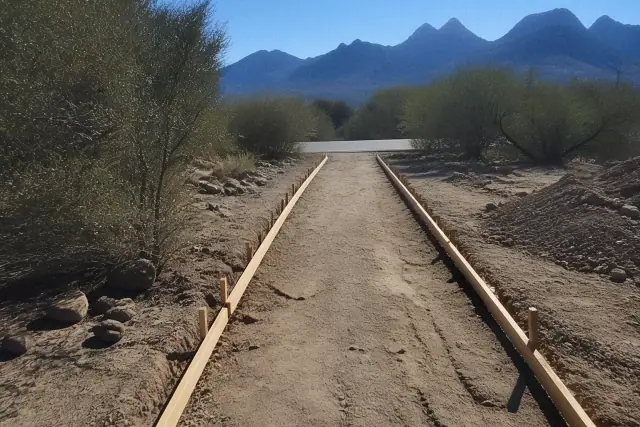
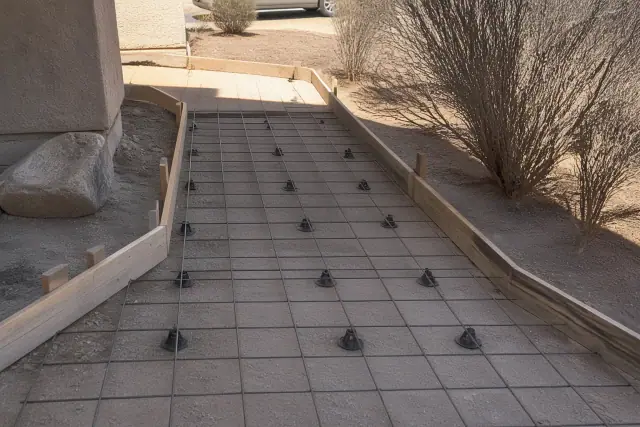
Wooden sidewalk forms with stakes set for a new walkway installation in Tucson, AZ, with mountains in the background.

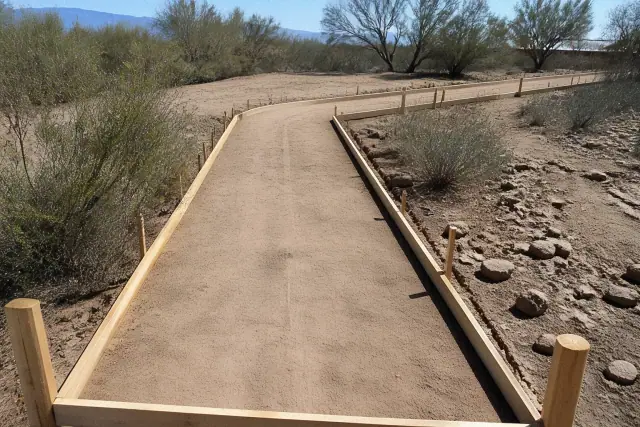
We install new entry walks, side-yard paths, pool deck connectors, driveway aprons, and sidewalk systems for new construction. The scope includes excavation, base preparation, forms, reinforcement, concrete placement, finishing, joints, curing, and final inspection.

Request Estimate

Concrete Crack Repair and Sealing

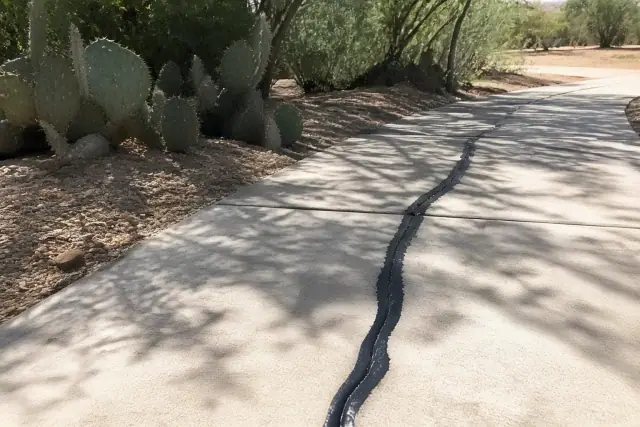
Concrete crack repair and sealing on a sidewalk in Tucson, AZ with desert landscaping and sunlight.

Repair may keep a sound panel in service when damage is limited. Depending on crack size and condition, work can include routing and sealing, epoxy or polyurethane injection, or resurfacing areas affected by spalling and efflorescence.

Request Estimate

Trip Hazard Leveling and Grinding

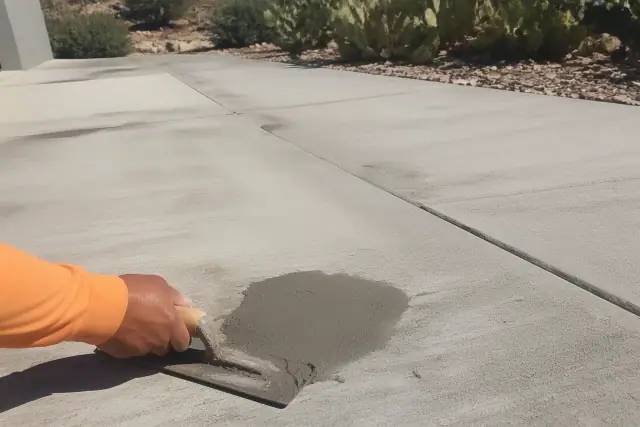
Concrete sidewalk repaired with grinding marks and bonding compound in Tucson, AZ, with prickly pear cactus in the

A sunken panel may be lifted back toward grade through concrete leveling, mudjacking, or slab jacking. Where adjoining panels create a raised lip, grinding can reduce the catch point without replacing otherwise serviceable concrete.

Request Estimate

ADA-Compliant Accessible Paths

ADA-compliant concrete path with a curb ramp and tactile warning surface in Tucson, AZ.

Accessible routes require coordinated width, running slope, cross slope, surface texture, joints, and transitions. Public and commercial paths can also require curb ramps with detectable warning surfaces where the walkway meets a street.

Request Estimate

Stamped and Decorative Walkways

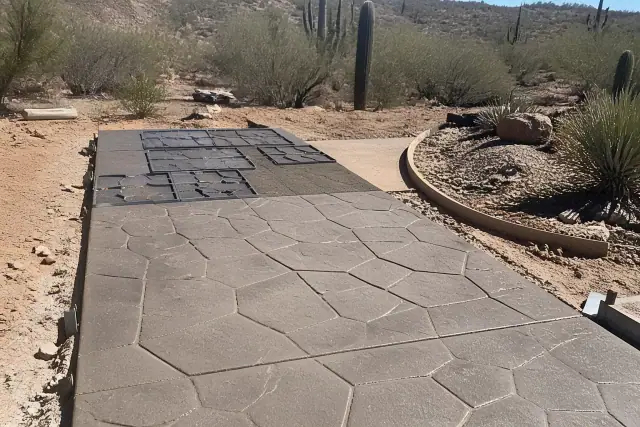
Textured concrete walkway with stone-like patterns being installed in a desert landscape in Tucson, AZ.

Stamped concrete can reproduce the look of flagstone, brick, or travertine at a fraction of the material cost. Concrete stain, integral color, exposed aggregate, and polished finishes provide additional ways to coordinate entry paths and pool connectors with the property.

Request Estimate

Concrete Sealing and Maintenance

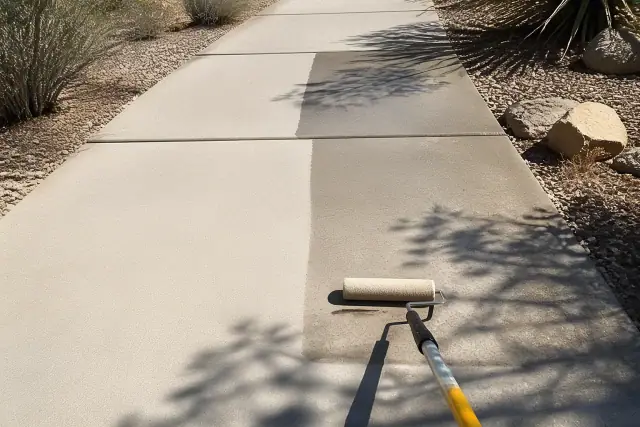
Contractor applying clear concrete sealer with a roller brush to a residential sidewalk in Tucson, AZ.

Sealer reduces water penetration and UV degradation and can include a slip-resistant additive for entry paths or pool areas. Power washing, post-monsoon joint inspection, and timely crack sealing help keep staining, efflorescence, and small defects from progressing.

Request Estimate
Finish and Build Options

Concrete Walkway Materials and Options

The right walkway assembly depends on use, soil movement, drainage, appearance, and whether repairs or removal are already part of the scope. These options cover standard pedestrian paths, loaded crossings, decorative surfaces, drainage-focused mixes, and restoration methods.

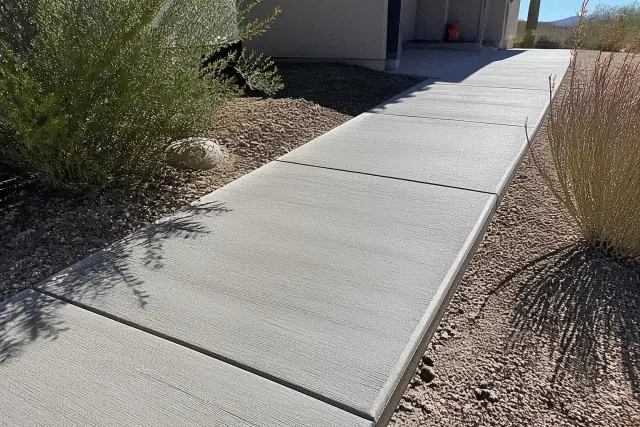
Standard broom-finished concrete sidewalk with desert landscaping in Tucson, AZ.

Standard Broom-Finished Concrete

A standard broom-finished path combines a compacted aggregate base, Portland cement concrete, a slip-resistant surface, and planned joints. It is a practical choice for front walks, side yards, and other everyday pedestrian routes.

  • Aggregate base compacted to roughly 95 percent density
  • Code-compliant pedestrian slab thickness
  • Smooth or broom finish selected for the route
  • Control joints planned to manage shrinkage cracking
  • Grade set toward approved drainage paths
Request Estimate
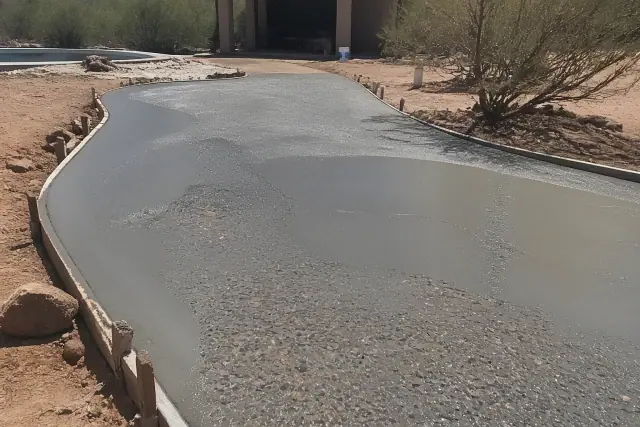
Freshly poured heavy-traffic concrete sidewalk at a residential jobsite in Tucson, AZ with desert surroundings.

Reinforced Heavy-Traffic Concrete

Driveway crossings, commercial paths, and other loaded areas require an assembly matched to traffic and soil conditions. Reinforcement and added thickness help distribute loads while the prepared base supports the slab.

  • Added slab thickness at vehicle-load crossings
  • Welded wire mesh for selected slab conditions
  • Rebar grids where soil movement or load calls for them
  • Fiber-reinforced options for high-traffic commercial paths
  • Mix and reinforcement chosen for residential or light commercial traffic
Request Estimate
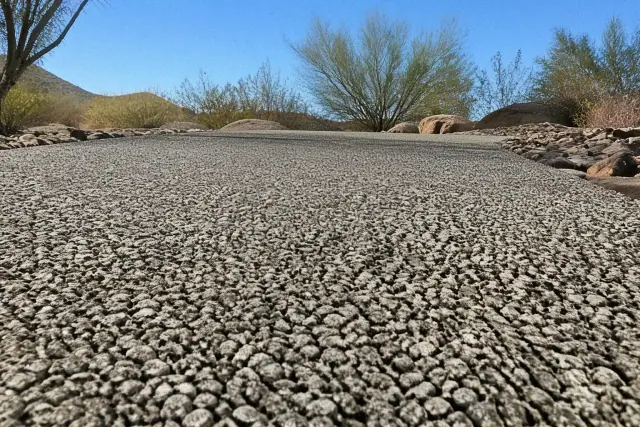
Exposed aggregate concrete sidewalk with partially visible pebbles in a Tucson, AZ patio setting.

Decorative and Exposed Aggregate Finishes

Decorative finishes change the texture, pattern, or color without changing the route's functional role. Selection should consider the home's exterior, surrounding hardscape, desert landscaping, and the desired level of visual pattern.

  • Flagstone-style stamped patterns
  • Brick-style stamped patterns
  • Travertine-style stamped patterns
  • Concrete stain or integral color
  • Exposed aggregate or polished concrete surfaces
Request Estimate
Permeable and recycled aggregate concrete sidewalk with desert sunlight and creosote bushes in Tucson, AZ.

Permeable and Recycled Aggregate Concrete

Permeable concrete lets water filter through the slab rather than sheet across its surface. Recycled aggregate mixes provide another option for property owners who want to prioritize material reuse without giving up the required strength.

  • Supports on-site water infiltration
  • Reduces surface sheet flow during monsoon runoff
  • Useful where property drainage is a design concern
  • Available with recycled aggregate mix options
  • Specified to retain appropriate walkway strength
Request Estimate
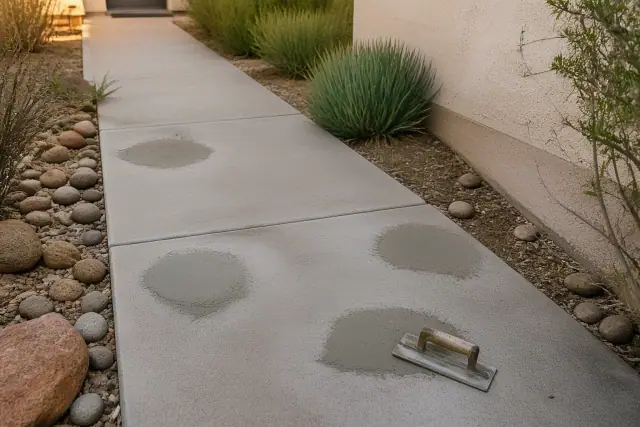
Contractor repairing a concrete sidewalk with bonding compound in Tucson, AZ, surrounded by desert landscaping.

Repair and Resurfacing Options

The condition of the panel and its base determines whether localized repair, leveling, resurfacing, or replacement is appropriate. Preserving sound concrete can reduce unnecessary removal while still addressing water entry, uneven edges, or surface wear.

  • Routing and sealing for suitable hairline cracks
  • Epoxy or polyurethane injection for larger structural cracks
  • Mudjacking or slab jacking for settled panels
  • Grinding for raised lips between panels
  • Resurfacing for spalling or efflorescence buildup
Request Estimate
Finding Your Right Fit

Choosing the Right Concrete Walkway Approach

The decision starts with how much of the panel is damaged, whether the base remains sound, and how the route will be used. We also consider caliche movement, drainage, accessible slopes, finish preferences, reinforcement, demolition, and budget before recommending repair or replacement. An estimator walks the site so the quote reflects the actual path and subgrade conditions.

Caliche-Specific Base Preparation

Dense caliche does not drain or compact like ordinary fill, and soft pockets can shift when monsoon moisture reaches them. We excavate to the required depth, remove or stabilize weak areas, compact aggregate, and grade the route before forms are installed.

Code-Aware Slopes and Joints

We set line and grade around Tucson code requirements and, where applicable, the ADA Standards for Accessible Design and Public Right-of-Way Accessibility Guidelines. Joint placement, surface texture, transitions, and drainage are checked as functional parts of the walkway rather than cosmetic afterthoughts.

One Crew and One Point of Contact

A single crew can coordinate a cracked entry panel, a full sidewalk, and related driveway, patio, or pool deck concrete as one project. We license and permit work through the appropriate Tucson and Pima County channels and explain base preparation, mix, reinforcement, and finish choices in plain terms.

What Sets Us Apart

Why Choose Us for Concrete Walkway Installation?

Our estimates start with an on-site review of the route, subgrade, drainage, access, and finish goals. That allows us to explain what base preparation and mix the project calls for, coordinate related concrete work under one scope, and provide a free quote without relying on a generic template.

Get a Free Quote

Cracked Concrete Panels

Hairline cracking may allow water and weeds into a panel, while a through-crack across the full width can signal more serious movement. Crack pattern, width, affected area, and base condition determine whether sealing, injection, resurfacing, or replacement makes sense.

Settled and Heaved Trip Hazards

A raised lip or sunken panel can catch shoes, wheels, or canes and create a liability concern. Leveling may lift a settled slab, grinding may reduce a high edge, and severe displacement may require panel replacement.

Caliche Movement and Monsoon Washout

Caliche can shift as moisture conditions change, and concentrated monsoon runoff can wash support from beneath a panel. Replacement alone will not solve the cause if weak pockets, failed base, or poor drainage remain below the new slab.

UV Wear, Spalling, and Fading

Intense UV exposure can break down an unsealed surface, contributing to spalling and color fading within a few years. Resurfacing can address suitable worn panels, while a compatible sealer helps reduce future UV and moisture exposure.

Poor Drainage Near Foundations

A walkway graded toward a building can concentrate monsoon water where it is least welcome. Correct line and grade carry runoff away from foundations and toward approved drainage paths while maintaining a usable walking surface.

Unsafe Slopes and Catch Points

Excessive slope, abrupt transitions, or poorly placed joints can make a route difficult for wheelchairs and canes. Accessible work controls running slope, cross slope, surface texture, expansion joints, and transition strips so edges do not become catch points.

How it works

Our Concrete Walkway Process

Each project moves from site evaluation and subgrade preparation through layout, reinforcement, placement, curing, and inspection. The sequence keeps soil, drainage, load, finish, and access requirements connected throughout the build.

01.

Site Evaluation and Estimate

An estimator walks the route to review existing concrete, caliche conditions, drainage, access, vehicle crossings, and finish goals. The quote accounts for square footage, thickness, demolition, base work, reinforcement, and finish selection.

02.

Excavation and Caliche Stabilization

The route is excavated to the required depth, and soft caliche pockets are removed or stabilized. Existing concrete is demolished and removed when replacement is part of the project.

03.

Base Compaction and Grading

Aggregate base is compacted, and the path is graded to carry water away from foundations toward approved drainage. This step provides uniform support before any forms or reinforcement are placed.

04.

Forms, Joints, and Reinforcement

Forms establish line and grade, while wire mesh, rebar, or fiber reinforcement is selected for soil movement and load. Expansion joints are set at logical breaks, and control-joint layout is planned before placement.

05.

Concrete Placement and Finishing

Concrete is placed for the route's residential or light commercial use and finished with a smooth, broom, textured, or selected decorative surface. Control joints are cut at the planned intervals to manage shrinkage as the slab cures.

06.

Curing and Final Inspection

A curing compound is applied, and fresh concrete is protected for a minimum seven-day cure window before foot traffic. The final check covers slope, joint spacing, surface finish, transitions, and edge work against applicable Tucson requirements.

Plan Your Project

Schedule a Concrete Walkway Project Consultation

Request a free, no-obligation quote for a new walkway, panel replacement, leveling, decorative finish, accessible route, or maintenance scope. We will review the site and explain the recommended base, mix, reinforcement, finish, and curing plan.

Sidewalk and Walkway Help

Concrete Sidewalk and Walkway FAQs

These answers cover Tucson walkway lifespan, thickness, cost, repair thresholds, accessible-route dimensions, finishing, curing, and maintenance. A site evaluation is still needed to account for the actual caliche, drainage, load, and existing panel conditions.

Call Our Experts

Concrete sidewalks generally last about 25 to 80 years, depending on soil movement, installation quality, and maintenance. Tucson's clay-caliche subgrade can shorten that range when the base was not compacted correctly or drainage undermines the slab.

Tucson Unified Development Code Section 4.3 requires sidewalks to be at least four inches thick. Areas that carry vehicle loads, such as driveway aprons crossing the sidewalk, are typically poured five to six inches thick.

Residential and light commercial walkways use a 3,000 to 4,000 PSI mix selected for the expected traffic and site conditions. Wire mesh, rebar, or fiber reinforcement may be added based on load and soil movement.

Installation generally runs $6 to $12 per square foot, or about $25 to $55 per linear foot for a standard four-foot-wide walkway; basic residential projects often total $2,150 to $6,500. Repair runs about $3 to $8 per square foot, while removal and replacement runs about $5 to $10 per square foot. Ready-mix is around $175 per cubic yard, a partial-load fee can be near $220, and a small path using about 2.5 yards can approach $650 in material before labor and finishing.

A straightforward residential walkway can move from preparation to finished placement within a few days, but weather and permit processing through the City of Tucson or Pima County can affect scheduling. Curing time is added before the walkway is opened for use.

Fresh walkway concrete is protected through a minimum seven-day cure window before foot traffic. A curing compound and seasonal moisture-control adjustments are especially important during Tucson's summer heat.

Repair is usually considered when damage affects less than about 25 to 30 percent of a panel and the base is still sound. Replacement is recommended when a panel has settled more than an inch, has a through-crack across its full width, or rests on a base damaged by washout or caliche movement.

Hairline cracks under a quarter inch can often be routed and sealed, while larger structural cracks may use epoxy or polyurethane injection. Sunken panels may be lifted through mudjacking or slab jacking, and raised lips can sometimes be ground down.

Accessible routes typically require 36 to 48 inches of clear width depending on path classification, with running slope capped at 5 percent and cross slope limited to 2 percent. Slip-resistant texture, controlled transitions, and detectable warning surfaces at curb ramps also support safe access.

Control joints give shrinkage cracking a planned location as concrete cures and the ground moves. Typical walkway joints are cut every four to five feet, while layout also considers the general interval of roughly two to three times the slab thickness in feet and logical expansion-joint breaks.

Resealing every two to three years is recommended under Tucson sun exposure, with shorter intervals for high-traffic commercial paths. Joint inspection after monsoon season, power washing, and sealing small cracks before winter can help prevent larger repairs.

Options include stamped flagstone, brick, or travertine patterns, plus concrete stain and integral color. Exposed aggregate and polished finishes are also available for entries and pool deck connectors where texture and appearance both matter.

Service is available throughout Tucson, Oro Valley, Marana, Sahuarita, and the greater Pima County metro area. Projects include residential paths in historic midtown neighborhoods and commercial routes near areas such as the University of Arizona corridor, Reid Park, and the Rillito River Path.