Installed Price Range
Straightforward 4-inch reinforced flatwork in Pima County averages $6.11 per square foot, with a typical range of $5.78 to $6.43 per square foot.
Most homeowners planning a slab pour in Tucson can expect to pay $6 to $12 per square foot installed, although thickness, reinforcement, site preparation, and finish can shift the final price. This guide from Tucson Superior Concrete explains the ranges and project details worth comparing before requesting a site-specific quote.
Straightforward 4-inch reinforced flatwork in Pima County averages $6.11 per square foot, with a typical range of $5.78 to $6.43 per square foot.
Wire mesh adds roughly $0.50 to $1.00 per square foot, while #3 or #4 rebar on 18-24-inch grid spacing adds $1 to $2 per square foot. A 6-inch slab uses roughly 25-35% more material volume than a 4-inch slab.
Multiply length by width for the base area, then allow 10-15% for waste and forming. A site walk is still important because soil, access, base preparation, reinforcement, and finish determine the firm quote.
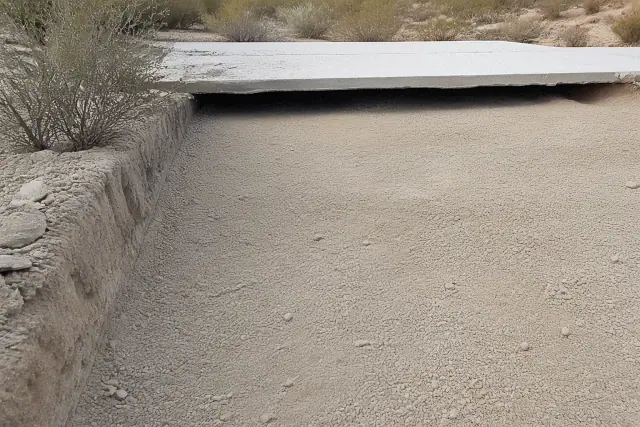
A cutaway view should show grading, compaction, reinforcement, and the slab above Tucson's caliche soil. These hidden preparation layers help explain why two slabs with the same dimensions can receive different quotes.
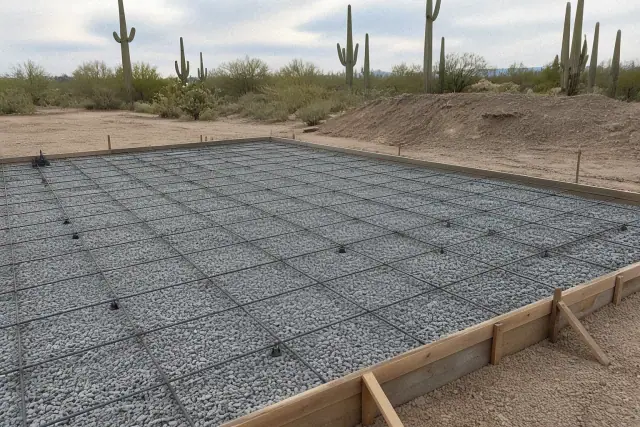
A close view of rebar supported within the slab should make the reinforcement layout easy to compare with wire mesh. Structural slabs generally use rebar for better load distribution.
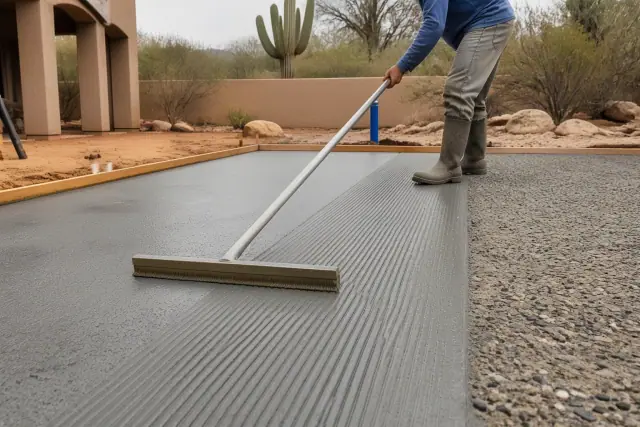
A side-by-side finish sample should show the visual and labor differences behind each price tier. Exposed aggregate adds $2 to $4 per square foot, stamped concrete adds $3 to $8, and colored concrete adds $1 to $3 over plain gray flatwork.
A 20x20 slab covers 400 square feet and typically costs $3,500 to $7,000 installed in Tucson, depending on thickness, base preparation, reinforcement, and finish.
A 24x24 slab covers 576 square feet and generally runs $7,500 to $12,500 with base compaction and a standard broom finish.
A 40x60 slab at 4 inches thick covers 2,400 square feet and generally costs $9,600 to $19,200. Shop, garage, and commercial-pad designs may need thicker sections or added rebar.
Ready-mix concrete in Arizona costs about $114 to $175 per cubic yard delivered before forming, labor, and finishing. Small-load fees can apply below a 5-yard minimum.
| Slab or Finish | Typical Installed Price | Main Cost Driver |
|---|---|---|
| Plain 4-inch flatwork | $4 to $8 per square foot | Basic patios, sidewalks, and light-duty slabs |
| 6-inch slab | $6 to $10 per square foot | Extra concrete for driveways, RV pads, or equipment areas |
| Reinforced driveway | $8 to $12 per square foot | Base preparation, reinforcement, control joints, and broom finish |
| Patio slab | $8 to $16 per square foot | Selected finish and site preparation |
| Sidewalk or walkway | $6 to $10 per square foot | Grading, slope, and access |
| Stamped concrete | $10 to $18 per square foot | Color hardener, release agent, texture skins, and sealing |
| Pool deck | $10 to $18 per square foot | Slip-resistant texture and heat-conscious finish |
| Commercial slab | $8 to $16 per square foot | Higher-strength mix, thicker sections, and grading requirements |
Statewide figures place new slab installation at $4.10 to $8.30 per square foot and ready-mix material alone at about $114 per cubic yard, while Tucson homeowners commonly budget $6 to $12 per square foot installed. A plain utility slab can fall near the low end, but an integrated patio, driveway, foundation, or pool deck needs a scope-specific comparison; a basic 4-inch reinforced shed, HVAC equipment, or workshop pad typically costs $6 to $10 per square foot. For example, a 20x20 slab quoted at $3,500 to $7,000 works out to roughly $9 to $17.50 per square foot once labor, forming, and finishing are included. Soil and access also matter: conditions near Marana and the Catalina foothills can differ from Rincon Valley sites, while infill work in Barrio Viejo presents different access than new construction in Vail or Sahuarita Heights.
Thickness, reinforcement, finish, access, and preparation all change the installed total. A standard two-car driveway of roughly 600 square feet typically costs $4,800 to $7,200, with control joints spaced every 10 to 12 feet; foundation and footing work may require deeper excavation, vapor barriers, and added steel. Grading, compaction, and vapor-barrier preparation add $1 to $3 per square foot, while demolition and removal of an old slab costs $2 to $6 per square foot. Tucson labor averages $50 to $75 per hour per crew member, and ready-mix delivery can add $75 to $150 per load, with short-load charges for orders under 5 cubic yards. Pool-deck pricing also reflects slip-resistant texture and heat-conscious materials because surface temperatures can exceed 140°F in July. Reinforcement placement, ACI-guided control-joint planning, ADA-compliant grading where applicable, and inspections through Pima County Development Services can further affect the scope. Avoid comparing per-square-foot quotes until thickness, base preparation, reinforcement, finish, delivery, and demolition are scoped the same way; summer moisture loss and monsoon forecasts can also affect pour timing and curing plans.
How long does a slab need to cure? A typical slab needs about 7 days before foot traffic and 28 days to reach full strength; careful preparation, curing, and joint placement can help it last 20-30 years. What strength is common? Residential flatwork generally uses 3,000 to 3,500 PSI concrete, while driveways and foundations often specify 4,000 PSI. The 4-2-1 rule describes 4 parts gravel, 2 parts sand, and 1 part cement, although ready-mix designs are adjusted for the required strength. Is repair less expensive than replacement? Resurfacing typically costs $3 to $7 per square foot, individual crack repair ranges from $250 to $800, and sealing costs $0.50 to $1.50 per square foot with reapplication every 2 to 3 years. So-called poor man's concrete omits professional forming, reinforcement, or finishing and is not recommended for permanent or load-bearing slabs.
Share the slab's length, width, intended use, thickness, reinforcement, access, and finish goals. A site walk can account for Tucson soil and base conditions before the scope and price are finalized.