Cracks Can Still Form
Stamped concrete is still a concrete slab. Well-planned control joints reduce random cracking, but they cannot guarantee a crack-free surface as the slab cures or the soil moves.
If you're weighing a stamped concrete patio, driveway, or pool deck for a Tucson property, Tucson Superior Concrete explains the trade-offs before you sign a contract. The biggest downsides are possible cracking, slippery wet surfaces, UV-driven color loss, recurring resealing, and repairs that rarely blend perfectly.
Stamped concrete is still a concrete slab. Well-planned control joints reduce random cracking, but they cannot guarantee a crack-free surface as the slab cures or the soil moves.
Stamping creates a smoother, tighter texture than a broom finish, so wet patios, walkways, and pool decks need a slip-resistant additive in the topical sealer.
UV exposure and traffic wear down the sealer film that protects decorative color. Resealing is an ongoing maintenance cost, not a one-time installation step.
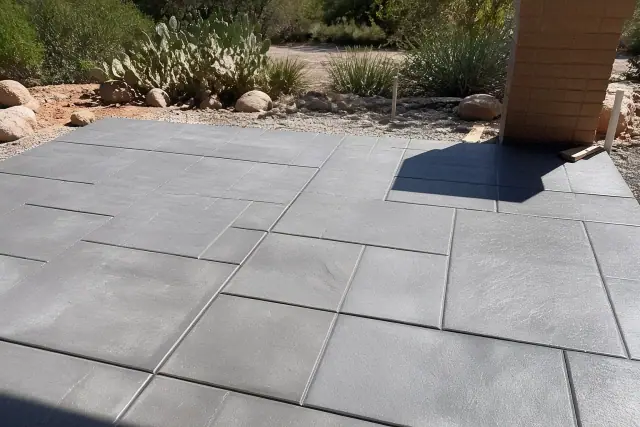
Show how planned joint lines fit within a stamped pattern. Their placement helps direct shrinkage cracks without eliminating cracking risk.
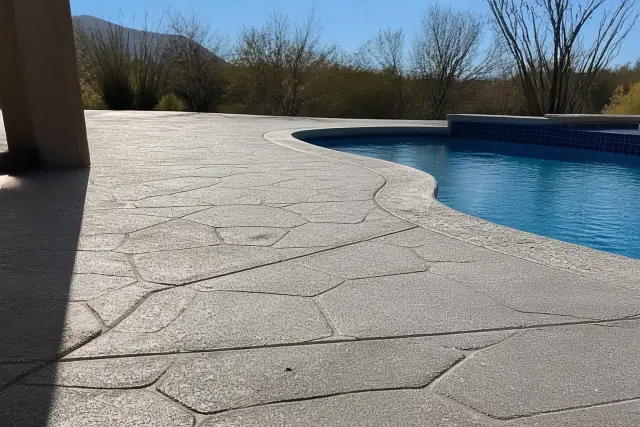
Show water on a textured pool-deck surface with a slip-resistant sealer additive. This is where traction matters most.
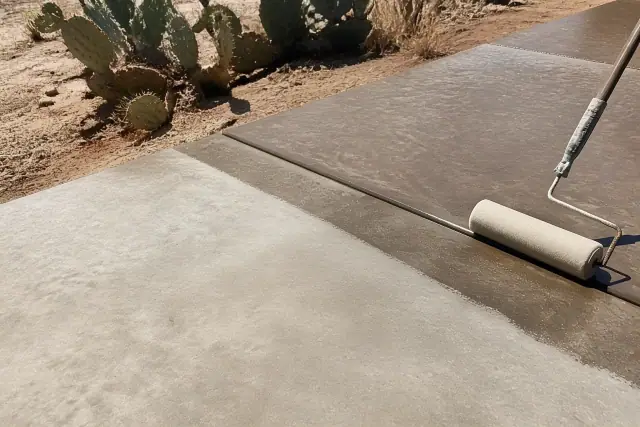
Show a side-by-side surface with chalky, faded color and a freshly resealed finish. The contrast makes Tucson's UV maintenance burden visible.
A 20 × 20-foot patio covers 400 square feet. Standard patterns such as ashlar slate or running bond generally run $10-$20 per square foot installed, or about $4,000-$8,000.
Elaborate multi-color or hand-engraved work can exceed $10,000 at $25 or more per square foot, while high-end intricate multi-color designs may reach $35-$60 per square foot. Final cost varies with base preparation depth, reinforcement, integral color versus color hardener, pool-deck tie-ins, and whether Pima County Development Services permitting applies.
Most stamped surfaces under normal foot traffic need resealing every 2-3 years at $0.75-$1.50 per square foot. For a 400-square-foot patio, that is roughly $300-$600 each cycle.
Pool decks and driveways may need sealer every 18-24 months because UV exposure, chemical contact, and surface wear are heavier.
| Downside | Why It Happens | What Helps |
|---|---|---|
| Random cracking | Concrete cures while Tucson soil shifts with monsoon moisture. | Compact and moisture-condition the subgrade, then plan contraction joints. |
| Slippery when wet | Stamping compresses the surface into a smoother texture. | Mix a slip-resistant additive into the topical sealer. |
| UV fading | Strong sun breaks down pigment and the sealer film. | Reseal before the protective film wears thin. |
| Visible repair mismatch | Stamp patterns and color batches rarely align perfectly. | Compare patching with resurfacing or replacement. |
Stamped concrete is standard concrete that is textured and colored before it cures, so it inherits ordinary slab problems and adds decorative-finish concerns. The stamping window can close within minutes once the concrete reaches the right plastic state, making the work unfriendly to DIY installation. Uneven release-agent application can leave inconsistent color, and the pattern layout is not realistic to change after stamping. Those drawbacks make crew timing and finish experience especially important.
Tucson avoids the severe freeze-thaw cycles common in colder climates, but expansive clay, hardpan caliche, rapid monsoon downpours, and wide daily temperature swings still stress slabs and sealer. Correctly compacting and moisture-conditioning the subgrade helps limit movement. A 4,000 psi mix suited to Southern Arizona conditions can reduce risk, although hairline cracks may still appear during the slab's first year. On pool decks, chlorine, calcium buildup, and sunscreen residue gradually abrade the sealer and leave an uneven, dulled finish.
How does stamped concrete compare with pavers? For the same 400-square-foot footprint, pavers often cost $3,000-$12,000 more, although stamped concrete adds recurring sealer expense. Can damaged stamped concrete be patched? It can, but the stamp lines and color batches rarely match exactly. When is a patch less practical? More than 1/4 inch of vertical displacement or spalling across more than roughly one-quarter of the surface generally points toward resurfacing or replacement.
Share the planned surface, approximate dimensions, pattern and color goals, and whether it connects to an existing pool deck. A local concrete team can help you compare installation cost, maintenance, and repair trade-offs before you approve the work.