Proudly serving Tucson, Oro Valley, Marana, Sahuarita, Green Valley, Vail & surrounding areasCall or Text 24/7: 520-699-3263
Guides

What are the common signs of trouble in a concrete driveway ?

If your driveway is cracking, sinking, flaking, or staining, Tucson Superior Concrete can help you recognize which problem you are seeing and why it matters. Across Tucson, these recurring problems usually point to soil movement, moisture, drainage, surface wear, or installation shortcuts, and spotting the pattern early helps distinguish routine maintenance from structural repair.

Quick Summary

  • Cracking is the most common concrete driveway problem in Tucson, where caliche soil and sharp monsoon moisture swings place stress on the slab.
  • Settling, heaving, and potholes usually point to weak subgrade compaction, expansive soil, pooling water, or erosion beneath the panels.
  • Spalling, scaling, fading, and stains are surface problems linked to the mix, finishing and curing, intense UV exposure, trapped moisture, or contaminants.
  • Widening cracks, standing water, chipped edges, visible spalling, or panels that have settled or heaved deserve a closer inspection.

Why Concrete Driveways Fail

Cracking Is Most Common

Concrete cracks when soil movement, moisture changes, vehicle loads, or poorly placed control joints concentrate stress in the slab. Failed joint sealant then lets water reach the base and can turn a visible crack into a deeper problem.

Soil, Moisture, and Installation

Expansive clay pockets within Tucson's dense caliche can swell after heavy rain, while poorly compacted subgrade can settle under vehicle weight. Thin slabs, missing reinforcement, rushed curing, and incorrect slope make that movement more damaging.

Inspect Before Choosing a Fix

Measure crack width and depth, look for panel movement, inspect the joints, and check the surrounding grade after rain. Those findings determine whether sealing, patching, injection, resurfacing, partial slab work, or replacement fits the damage.

Driveway Damage to Inspect

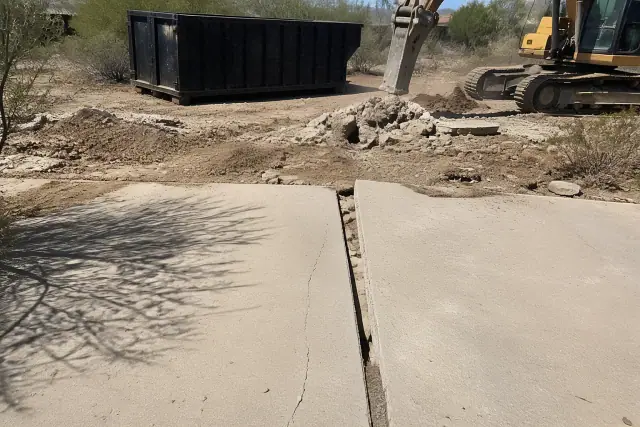
Wide Crack Beside a Settled Driveway Panel

Wide crack beside a settled driveway panel during a concrete removal project in Tucson, AZ.

Both the crack opening and the height difference between panels. Visible movement suggests that soil or base conditions matter more than a cosmetic surface patch.

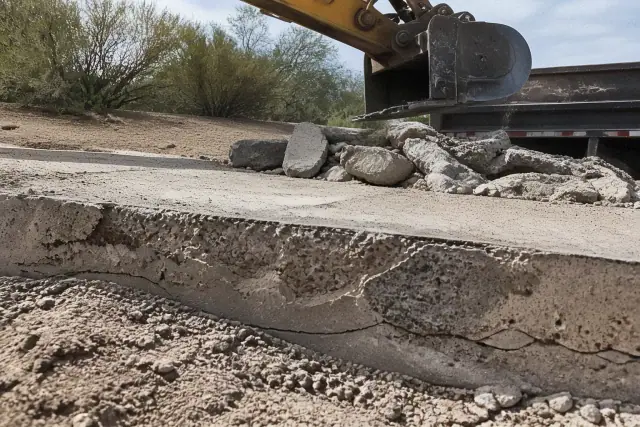
Spalling, Scaling, and Embedded Stains

Heavy machinery breaking up worn concrete with spalling and scaling in a Tucson, AZ landscape.

A close view should distinguish chunky spalling, thin scaling flakes, and discoloration from oil, rust, fertilizer, or white mineral efflorescence left as hard water and dissolved minerals reach the surface. Each condition points to a different cleaning, sealing, repair, or resurfacing decision.

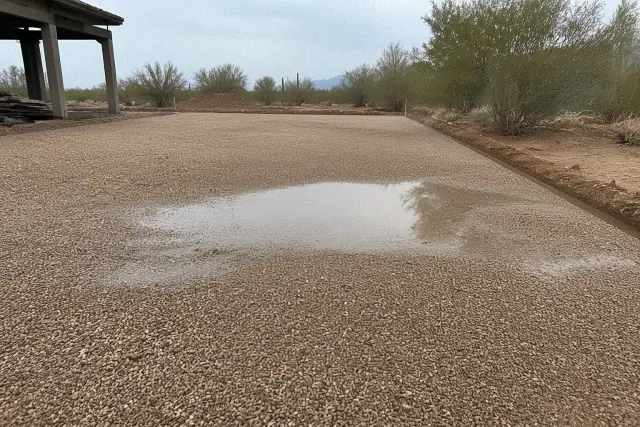
Standing Monsoon Water at a Low Spot

Standing monsoon water pooling on a leveled gravel driveway subgrade at a jobsite in Tucson, AZ.

Runoff collecting near a low panel or deteriorated joint instead of moving away from the garage and foundation. Pooling water can saturate and erode the base beneath the driveway.

Concrete Driveway Snapshot

Measure the Cracks

Hairline cracks may only need flexible sealant, but openings wider than 1/4 inch or cracks paired with movement call for inspection of the slab and base.

Watch Water and Movement

Standing water after storms, failed joint sealant, depressions, heaved edges, and rocking panels indicate that drainage or subgrade conditions may be driving the damage.

Compare Repair Costs

Simple patching or minor crack repair typically runs $100-$500. A concrete overlay generally runs $3-$7 per square foot when the base remains sound but the surface has aged.

Know When Replacement Fits

Full replacement runs roughly $6-$12 per square foot for a basic residential driveway and often becomes more economical once damage covers more than roughly 25-30% of the surface. Repairs involving base work or partial slab replacement can range from a few hundred dollars to $15,000 or more, depending on scope.

Repair or Replacement Chart

Observed conditionLikely concernPractical next action
Hairline, isolated crack with no movementMinor surface stressClean and seal with a flexible polymer-modified sealant, then monitor it.
Wide crack or uneven panelStructural movement or base failureCheck crack depth, load transfer, drainage, and the subgrade before selecting a repair.
Spalling or scaling over a sound baseSurface wear, mix, finishing, or curing damageCompare localized repair with a resurfacing overlay.
Widespread cracking, heaving, or settlementDamage extends beyond the surfaceCompare partial slab work with full replacement.

Why Tucson Driveways Deteriorate

Across Tucson and Pima County, dense, poorly draining caliche expands and contracts as moisture changes, so stress builds where the slab cannot move as intended. On a 4-inch slab, control joints are typically spaced every 8-10 feet; wider spacing gives cracking more room to develop. Settling and heaving become more likely when the subgrade was not compacted to the proper density, usually 95% Proctor compaction, or when expansive clay pockets swell after rain. A driveway should slope roughly 1/4 inch per foot away from the garage and foundation so runoff does not saturate and erode the base. Spalling and scaling add another layer of damage when a high water-to-cement ratio, early finishing, trapped moisture, or rushed hot-weather curing weakens the surface.

Installation and Climate Factors

Crazing within the first year, inconsistent color, shallow or late-cut joints, and unexpected standing water can reveal poor installation. For Tucson conditions, a minimum 4000 psi mix with wire mesh or rebar is stronger than the 3000-3500 psi minimum often used elsewhere and helps account for soil movement and heat. Monsoon season typically runs from July through September, testing drainage and joint sealant, while unshaded concrete surface temperatures can exceed 140 degrees and make curing timing critical. Occasional December and January frosts can still widen moisture-filled cracks, although freeze-thaw damage is far less common here than in colder regions. Mesquite and palo verde roots can lift slab edges, while pool chemicals, fertilizer runoff, and softener salt can pit or stain the surface if they are not rinsed away promptly.

Common Follow-Up Questions

How long should a driveway last? A well-installed concrete driveway typically lasts 25-30 years and up to 30-40 years with good conditions and consistent sealing; colder climates often see closer to 20 years because of freeze-thaw cycling, which affects Tucson far less. How often should it be sealed? Apply a penetrating sealer every 2-3 years, rinse away oil, fertilizer, pool chemicals, and salt promptly, and keep drainage paths clear. Can cracks be repaired? Hairline cracks can take flexible polymer-modified sealant, structural cracks may need epoxy or polyurethane injection, and widespread cracking across multiple panels may call for an overlay or replacement after the base is assessed.
Concrete Driveway Guidance

Need Help Evaluating Your Driveway?

Share where cracks, settlement, staining, or pooling appear and when the condition changed. An inspection can compare crack width and depth, panel movement, joint condition, drainage, grading, and the base before you choose patching, resurfacing, partial slab work, or replacement in Tucson. If replacement is being considered, ask how the proposed slab, reinforcement, joints, slope, mix strength, and curing plan align with American Concrete Institute guidance for residential flatwork.